The 1996-97 NBA Hoops Kobe Bryant Rookie Card: What It’s Really Worth in 2026
A raw 1996-97 Hoops Kobe Bryant rookie card sells for around $20 to $30 today. A PSA 10 version of that exact same card recently sold for close to $1,000. That gap tells you almost everything you need to know about this hobby, and about this card in particular.
If you’re holding one of these cards, thinking about buying one, or just curious what all the fuss is about, here’s a clear, current breakdown of what it’s worth, why the price swings so much, and what to watch out for before you spend a dollar.


#Paid Links
Quick facts before we dig in:
- Card: 1996-97 NBA Hoops, card #281, Kobe Bryant, Los Angeles Lakers
- Manufacturer: SkyBox
- Raw (ungraded) value: roughly $15 to $30
- PSA 10 value: roughly $600 to $1,000, though it has traded higher and lower depending on the month
- This is one of several Kobe Bryant rookie cards from 1996-97, not the only one, and not the rarest one
Top 9 NBA Hoops Kobe Bryant Rookie Cards
- 1996 NBA Hoops Kobe Bryant Rookie Card
1. 1996 NBA Hoops Kobe Bryant Rookie Card

#Paid Links
The 1996 Hoops Kobe Bryant Rookie Card #281 stands out as a treasured piece for collectors following the NBA Hoops Kobe Bryant rookie card market.
This card has been professionally authenticated and graded PSA 8 by PSA, carrying certification number 47022160 for verified accuracy.
Produced by Powers Collectibles and offered through Powers Sports Memorabilia, this NBA Hoops Kobe Bryant rookie card highlights Kobe Bryant’s very first NBA season with the Los Angeles Lakers.
The PSA 8 grade reflects excellent condition, giving buyers confidence in both the authenticity and long term appeal of this 1996 NBA Hoops Kobe Bryant rookie card.
Collectors searching for a genuine skybox NBA Hoops Kobe Bryant rookie card often look for graded examples like this one, since third party grading adds a layer of trust to the purchase.
With a rating of EX and no autograph included, this card is positioned as a straightforward, well preserved rookie card rather than a signed memorabilia piece.
Powers Sports Memorabilia positions itself as a resource for collectors, offering guidance for those exploring the NBA Hoops Kobe Bryant rookie card value and its place within Kobe Bryant’s broader card history.
Whether someone is building a dedicated Kobe Bryant collection or simply wants a meaningful NBA Hoops Kobe Bryant rookie card to add to their gallery, this listing presents a graded option backed by an established grading authority.
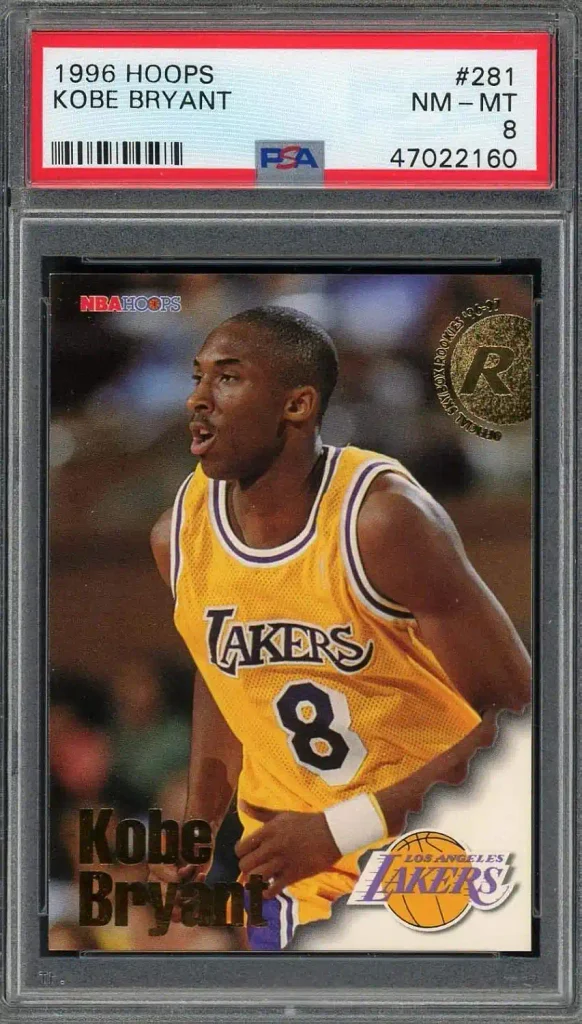
Image Credit: amazon.com
Key Features
- Professionally graded PSA 8 with certification number 47022160
- Authenticated by PSA, a trusted third party grading service
- Card number 281 from the 1996 NBA Hoops basketball card set
- Manufactured by Powers Collectibles under the Powers Sports Memorabilia brand
- Grade rating listed as EX (Excellent)
- No autograph included on this card
- Compact package dimensions of 7.8 x 5.91 x 0.43 inches
- Lightweight at approximately 2.89 ounces
- Backed by a free returns policy
- Sold through a small business seller
- Priced at $199.00
| Pros | Cons |
|---|---|
| Professionally graded by PSA for authenticity and trust | Card is not autographed |
| Represents Kobe Bryant’s rookie season with the Lakers | Grade rating listed only as EX rather than a higher condition |
| Comes with a verifiable certification number | Priced at $199.00, which may feel high for a PSA 8 grade |
| Backed by free returns for buyer peace of mind | |
| Sold through Powers Sports Memorabilia, a collector focused seller |
My Opinion
I prefer this NBA Hoops Kobe Bryant rookie card because it offers a trusted way to own a piece of basketball history without guesswork.
The PSA 8 grading gives me confidence that the card’s condition and authenticity have been verified by a respected third party.
I like that Powers Sports Memorabilia focuses specifically on helping collectors, which makes the buying experience feel more guided and less like a random online purchase.
Knowing the exact certification number also reassures me that the card can be checked and confirmed at any time.
For anyone drawn to Kobe Bryant’s legacy and the excitement of his debut season, this card feels like a meaningful and dependable choice within the wider Kobe Bryant rookie card list.
What Is the 1996-97 Hoops Kobe Bryant Rookie Card?
The 1996-97 Hoops Kobe Bryant is card number 281 in the second series of SkyBox’s 1996-97 Hoops basketball set. It shows Bryant in his Lakers uniform during his rookie season, the year he came straight to the NBA out of Lower Merion High School in Pennsylvania.
The 1996-97 Hoops set was released in two series that year: series one had 200 cards, and series two added 150 more, bringing in that year’s rookie class. Kobe Bryant’s card sits in series two alongside other rookies from what turned out to be one of the deepest draft classes in NBA history, including Allen Iverson, Stephon Marbury, Shareef Abdur-Rahim, Marcus Camby, and Antoine Walker.
Hoops packs sold for about $1.29 each and held 9 cards, so this wasn’t a premium, low-print product. Millions of these cards were produced, which is the main reason raw copies are still cheap today even though Bryant became one of the greatest players ever.
Why collectors still want it: it’s an affordable, widely recognized entry point into Kobe Bryant’s rookie card class. You don’t need thousands of dollars to own a piece of it, and a well-centered, sharp copy in high grade is genuinely a nice-looking card.
Is This Kobe Bryant’s Only Rookie Card?
No, and this is the single most common source of confusion for new buyers. Kobe Bryant has multiple rookie cards from the 1996-97 season, because several manufacturers (Topps, Fleer, Upper Deck, SkyBox, and others) all released basketball products that year. The Hoops #281 base card is just one of them.
Don’t confuse it with: the 1996 Hoops “Grant Hill’s All-Rookie Team” insert card, which also features Kobe Bryant and is numbered #3. That insert is a short-printed subset, far scarcer than the base card, and sells for dramatically more (PSA 10 copies have brought several thousand dollars at auction). If a listing says “1996 Hoops Kobe Bryant” but the card number is 3 and it mentions “All-Rookie Team,” you are looking at a completely different, much rarer card than the one this guide covers.
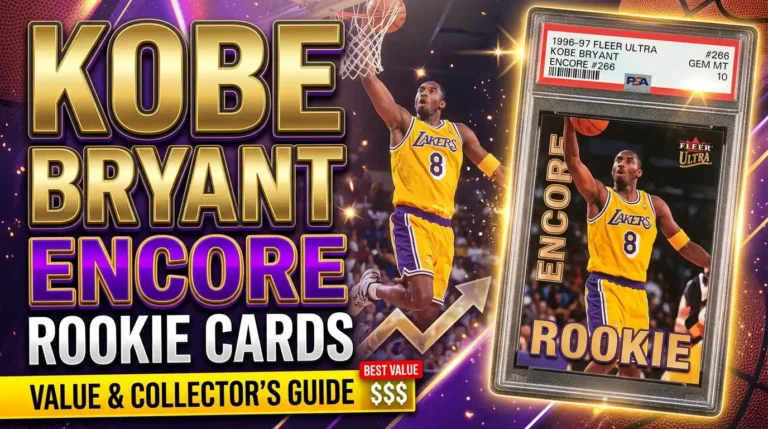
Other well-known 1996-97 Kobe rookies include the Topps #138, Topps Chrome #138, Fleer Ultra #52, Upper Deck #267, and SkyBox Z-Force #140, among others. Each has its own market and price range. The Topps base rookie is generally considered the most iconic of the bunch, but the Hoops #281 remains one of the most affordable ways to own a genuine Kobe rookie card.
1996-97 Hoops Kobe Bryant #281 Price Guide by Grade
Prices below reflect recent completed sales tracked through September 2026. Trading card prices move constantly and can vary by 20 to 30 percent week to week, especially at the highest grades where sales are infrequent, so treat these as a realistic range rather than a fixed number.
| Grade | Typical Price Range | Recent Market Price | Sales Frequency |
|---|---|---|---|
| Raw / Ungraded | $15 to $30 | ~$23 | Several sales per week |
| PSA 7 / NM | $25 to $47 | ~$37 | About 1 sale per month |
| PSA 8 / NM-MT | $40 to $140 | ~$64 | About 1 sale per week |
| PSA 9 / Mint | $75 to $145 | ~$110 | About 1 sale per week |
| PSA/BGS/SGC 9.5 | $70 to $480 | ~$199 | A handful of sales per year |
| PSA 10 / Gem Mint | $300 to $980 | ~$845 | About 1 sale per month |
A few things worth noticing in that table:
The jump from raw to PSA 8 is small. The jump from PSA 9 to PSA 10 is huge. That’s normal for this card and this era. PSA 9s pop up regularly because centering and edges on 1990s Hoops cards were inconsistent but survivable. True gem mint 10s are much harder to find because the printing and cutting process of the mid-90s wasn’t precise enough to produce large numbers of flawless copies.
PSA 10 pricing is volatile because volume is low. With only about one sale a month at that grade, a single high or low sale can swing the “market price” noticeably. Don’t panic if you see one PSA 10 sell for $500 and another for $950 within a few weeks; both are real, and the truth is somewhere in between depending on centering, timing, and how badly the two buyers wanted that particular copy.
9.5s are the wild card. Because SGC, BGS, and PSA all grade this card, and none of them use a “10” designation the same way, a 9.5 from one company is not automatically equivalent to a 9.5 from another. BGS 9.5 copies with strong subgrades have sold anywhere from about $80 to well over $400 depending on the exact subgrades and buyer demand at the time.
How Many Have Been Graded?
Based on aggregated third-party grading data, roughly 10,000 to 11,000 copies of this card have been submitted for grading across PSA alone, with PSA 8 being the single most common grade returned (over 3,000 copies). That’s a large population for a single card, which helps explain why prices at the lower and mid grades stay affordable. Gem mint 10s make up a small fraction of that total, which is the real driver of the price gap you see in the table above.
What Actually Drives the Price of This Card
1. Grade (Condition)
This is the single biggest factor. A card with sharp corners, tight centering (as close to 50/50 or 55/45 as possible), no surface scratches, and clean edges will grade higher and sell for a multiple of a similar-looking card that just misses the mark. On this card specifically, centering and corner wear from factory cutting are the most common reasons copies miss a 9 or 10.
2. Grading Company
PSA generally commands the strongest resale premium for this card among mainstream collectors, followed by BGS and SGC. That doesn’t mean SGC or BGS copies are worth less because they’re lower quality; it mostly reflects buyer familiarity and resale liquidity. A BGS 9.5 and a PSA 9 can sell for similar prices even though the number looks different.
3. Kobe Bryant’s Legacy and News Cycle
Demand for Kobe Bryant cards, including this one, tends to spike around his birthday (August 23), the anniversary of his passing (January 26), Hall of Fame or Lakers retirement-related events, and NBA Draft season when 1996 draft class nostalgia resurfaces. If you’re planning to sell, timing around these moments can meaningfully affect what you get.
4. Supply and Print Run
Because Hoops was a mass-market, affordable product in 1996, the print run was large. That keeps the raw and low-grade market accessible, but it also means truly pristine, high-population-report copies at the top grades are the scarce part of the equation, not the card itself.
Is the 1996-97 Hoops Kobe Bryant Rookie Card a Good Investment?
This isn’t financial advice, and nobody, including seasoned dealers, can reliably predict where a specific card’s price goes next. What can be said honestly:
- This is a mass-produced base card, not a rare, low-print insert. It’s unlikely to ever rival the value of Kobe’s Topps Chrome or Finest rookie cards, which are scarcer.
- Its value is closely tied to sports card market conditions generally, which have cooled somewhat since the speculative peak of 2020-2021, then found a steadier footing.
- Raw and mid-grade copies (PSA 7-9) are the most stable and liquid part of this card’s market; there is steady week-to-week trading volume.
- High-grade copies (PSA 9.5 and 10) are thinner markets. That can work in your favor if you catch a good sale, or against you if you need to sell quickly and there’s no active buyer that week.
A fair way to frame it: this card is a reasonably priced, historically meaningful way to own a piece of Kobe Bryant’s career, not a card most people should buy purely expecting significant appreciation.
How to Buy a 1996-97 Hoops Kobe Bryant Rookie Card Safely
- Decide raw vs. graded first. If you want the cheapest entry point and don’t mind grading it yourself later, buy raw and inspect photos closely for corner wear, surface scratches, and centering. If you want price certainty and easy resale, buy a card already graded by PSA, BGS, or SGC.
- Check the cert number. Every PSA, BGS, and SGC graded card has a certification number on the slab. Look it up directly on the grading company’s website (PSA’s cert verification, BGS’s cert lookup, or SGC’s lookup tool) to confirm the grade, card, and player match what’s listed. This takes 30 seconds and catches most reslabbing scams.
- Confirm the card number. Make sure the listing says card #281 and “Hoops” specifically, not “Grant Hill’s All-Rookie Team #3,” a different insert entirely, or a different Kobe product like Topps or Fleer Ultra.
- Compare recent sold listings, not asking prices. Active “Buy It Now” listings on eBay or elsewhere are often priced well above what the card actually sells for. Filter for sold and completed listings to see real transaction prices.
- Buy from sellers with strong, relevant feedback. Look for a track record of selling graded sports cards specifically, not just general high feedback in unrelated categories.
- Watch out for reholdered or swapped slabs. A small number of bad actors swap a lower-grade card into a higher-grade holder. Cert number verification is your main defense here.
How to Sell Your 1996-97 Hoops Kobe Bryant Rookie Card
- Get it graded if it’s in strong shape. A raw card that looks PSA 8 or better on close inspection is usually worth submitting for grading, since the price jump from raw to graded on this card is substantial relative to grading fees.
- Use clear, well-lit photos, front and back. Buyers pay more for listings where they can actually assess centering and corners themselves.
- Price against recent sold comps, not the highest listing you can find. Overpricing based on outlier sales usually just means your listing sits unsold.
- Consider timing. As noted above, listing around Kobe-related dates or NBA Draft season can help visibility and demand.
- Choose your marketplace based on grade. Lower-grade and raw copies move well on high-volume marketplaces like eBay. Higher-grade copies (PSA 9.5, PSA 10) sometimes do better through dedicated auction houses or sports card marketplaces where serious collectors are actively bidding.
You May Also Like to Read:
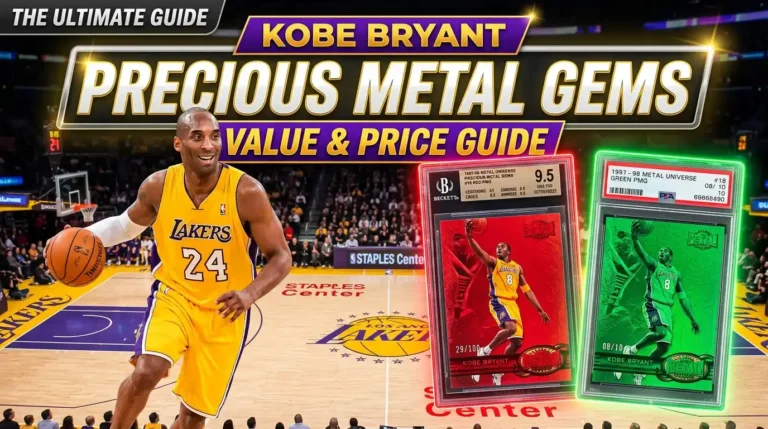
- Kobe Bryant Metal Universe Cards: The Complete Value and Price Guide
- Kobe Bryant Topps Rookie Card Value Guide: What It’s Really Worth in 2026
FAQs
How much is a 1996-97 Hoops Kobe Bryant rookie card worth?
Raw copies typically sell for $15 to $30. Graded copies range from roughly $35 for a PSA 7 up to $600 to $1,000 or more for a PSA 10, depending on current demand and how recently comparable copies have sold.
What card number is Kobe Bryant’s Hoops rookie card?
It’s card #281 in the 1996-97 NBA Hoops set, part of the set’s second series.
Is the 1996-97 Hoops Kobe Bryant card his true rookie card?
It’s one of several true rookie cards from his 1996-97 rookie season, since multiple manufacturers released Kobe rookie cards that year. It is a legitimate rookie card, just not his only one.
Why is the PSA 10 price so much higher than PSA 9?
Because 1990s cards were mass-produced with less precise cutting and centering than modern cards, flawless gem mint 10 copies are much rarer than near-flawless PSA 9 copies. That scarcity, combined with steady collector demand, creates a large price gap between the two grades.
What’s the difference between this card and the Kobe Bryant “Grant Hill’s All-Rookie Team” Hoops insert?
The All-Rookie Team card is a separate, short-printed insert numbered #3, not the base rookie card numbered #281. It’s far scarcer and sells for significantly more, especially in high grades.
Should I get my raw Hoops Kobe Bryant card graded?
If it looks sharp with good centering and no visible flaws, grading is usually worth it, since a PSA 8 or higher can sell for multiple times what a raw card brings. If it has visible creases, rounded corners, or off-center printing, grading fees likely won’t pay off.
Where can I verify a graded card is authentic?
Use the certification lookup tool on the grading company’s own website (PSA, BGS, or SGC) and match the cert number, card details, and grade exactly to what the seller lists.
Does centering matter a lot on this specific card?
Yes. Off-center printing is one of the more common issues that keeps this card out of the PSA 9 and 10 range, so it’s worth checking closely in listing photos before buying.
Are there parallel or refractor versions of this card?
The 1996-97 Hoops base set itself did not include chrome or refractor parallels; those came later in other Kobe rookie products like Topps Chrome. Within Hoops, the main variation to know about is the separate All-Rookie Team insert covered above.
Is now a good time to buy this card?
There’s no universally “right” time. Prices at the raw and mid-grade levels have been relatively stable, while PSA 10 prices have shown more volatility. Buying based on recent sold comps, rather than trying to time a bottom, is the more reliable approach.
Can I trust the price shown on a single price-guide website?
Treat any single site’s number as a starting point, not gospel. Cross-check recent sold listings on eBay, along with auction results from PSA’s own auction price database, to get a fuller picture before buying or selling.
Was Kobe Bryant’s rookie season 1996-97?
Yes. Bryant was drafted 13th overall by the Charlotte Hornets in the 1996 NBA Draft and immediately traded to the Los Angeles Lakers, where he played his entire rookie season in 1996-97.