Topps Chrome Kobe Bryant Cards: The Complete Value and Collector’s Guide
If you’re holding a 1996-97 Topps Chrome Kobe Bryant card and wondering what it’s actually worth, you’re not alone. This card sits at the center of one of the biggest stories in the modern sports card hobby, and its value swings enormously depending on which version you have, what grade it’s in, and when you’re checking the price.
Here’s the short version. A raw (ungraded) base card is worth somewhere in the range of $50 to $150 depending on condition. A PSA 10 base card currently sells in the $6,000 to $10,600 range. The Refractor parallel is a different animal entirely: a PSA 10 Refractor has sold anywhere from around $100,000 to well over $1 million, and one specific copy set an all-time Kobe Bryant record at $1,795,800 back in 2021.
Below, we’ll break down exactly why the numbers vary so much, what your specific card is likely worth, and how to buy, sell, or grade one without getting burned.


#Paid Links
Top 1 Topps Chrome Kobe Bryant Card
- Kobe Bryant 2003 Topps Chrome Basketball Card #36 Graded PSA 9
1. Kobe Bryant 2003 Topps Chrome Basketball Card #36 Graded PSA 9

#Paid Links
Kobe Bryant fans and basketball card collectors have a strong option in this 2003 Topps Chrome Basketball Card featuring Kobe Bryant, card number 36, professionally graded PSA 9. This Topps Chrome Kobe Bryant card comes from Powers Collectibles and represents Kobe Bryant during his time with the Los Angeles Lakers in the NBA.
The card has been authenticated and graded by PSA, one of the most trusted names in the sports card grading industry. This PSA 9 grade reflects a card in excellent, near mint condition, making it an appealing pick for anyone searching for a mint Topps Chrome Kobe Bryant card without paying gem mint prices.
This particular card is not autographed, keeping it priced at $199.00, which places it comfortably in the range collectors often look for when searching for a Topps Chrome Kobe Bryant card under $2,000. It ships in secure packaging weighing about 1 pound, with package dimensions of 8 x 6 x 1 inches, so it arrives protected and ready to display or store safely.
Whether picked up for a personal basketball card collection or as a gift for a Kobe Bryant fan, this graded card offers a reliable, verified way to own a piece of Kobe Bryant memorabilia from the 2003 Topps Chrome set.
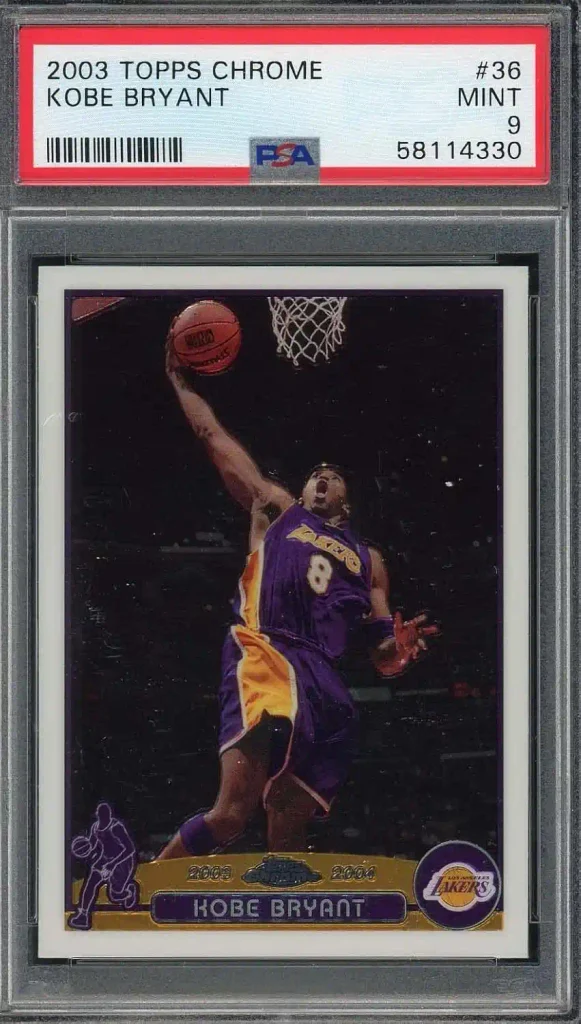
Image Credit: amazon.com
Key Features
- Officially graded PSA 9 by PSA, a leading sports card grading company
- Card number 36 from the 2003 Topps Chrome Basketball set
- Features Kobe Bryant of the Los Angeles Lakers, NBA
- Not autographed
- Sold by Powers Collectibles
- Package weight of 1 pound with dimensions of 8 x 6 x 1 inches
- First available November 21, 2021
- Priced at $199.00, an accessible entry point for collectors
| Pros | Cons |
|---|---|
| Professionally graded PSA 9 for verified condition and authenticity | Card is not autographed |
| Features Kobe Bryant, one of basketball’s most collected athletes | |
| Affordable price point for a graded Topps Chrome Kobe Bryant card | |
| Ships securely with protective packaging | |
| Makes a strong gift option for basketball card collectors |
My Opinion
If I were adding to a basketball card collection, this is the kind of Topps Chrome Kobe Bryant card I would seriously consider. Having it graded PSA 9 gives me confidence in its condition and authenticity, since that verification removes a lot of the guesswork that comes with buying sports cards online.
I also like that it’s priced at $199.00, which feels reasonable for a graded Kobe Bryant card and fits well within a budget for collectors looking at cards under $2,000. It strikes a nice balance between quality and affordability.
For anyone who wants a piece of Kobe Bryant history without stretching for an ungraded or unverified card, this one stands out to me as a smart, low-risk choice for a collection or as a thoughtful gift.
What Is the Topps Chrome Kobe Bryant Card?
The Topps Chrome Kobe Bryant card is card #138 from the 1996-97 Topps Chrome basketball set, a 165-card release that used Topps’ chromium printing technology to give the same base design from the standard 1996-97 Topps set a glossy, reflective finish. It’s widely considered Kobe Bryant’s single most important rookie card.
Kobe was picked 13th overall by the Charlotte Hornets in the 1996 NBA Draft and traded to the Los Angeles Lakers on draft night, making him the first guard ever drafted directly out of high school. That rookie status, combined with his 20-year Hall of Fame career entirely with the Lakers and his tragic death in a 2020 helicopter crash, is what turned this card into a cornerstone of the hobby.
Key facts about the card:
- Set: 1996-97 Topps Chrome
- Card number: 138
- Player: Kobe Bryant (Los Angeles Lakers)
- Card type: Rookie card
- Parallel: Refractor (limited print run, estimated around 742 copies)
- Standard card size: 2.5 x 3.5 inches
Topps Chrome Kobe Bryant Base Card vs Refractor: What’s the Difference?
This is the single most important distinction to understand, because confusing the two is the number one reason people misjudge what they own.
The base card has the same chrome, reflective finish as every card in the set. It’s plentiful. PSA alone has graded more than 7,000 copies of it.
The Refractor is a parallel version that uses a special coating to produce a rainbow, prism-like shine when tilted under light. It was inserted far less frequently into packs, and its far smaller print run is the entire reason its value is measured in tens or hundreds of thousands of dollars rather than hundreds.
| Feature | Base Card | Refractor Parallel |
|---|---|---|
| Visual finish | Standard chrome shine | Rainbow, prism-like reflective shine |
| Estimated population (PSA graded) | Over 7,000 copies | Around 430 copies |
| PSA 10 population | 840 | 63 |
| PSA price guide value (PSA 10) | $8,750 | $135,000 |
| Typical recent sale (PSA 10) | $6,000 to $10,600 | $100,000+ |
| Rarity | Common | Extremely scarce |
How to tell them apart: Hold the card at an angle under a light. The base card reflects light in a fairly uniform chrome shine. The Refractor produces a visible color shift, a rainbow or prism effect, as you tilt it. If you’re not seeing that rainbow effect, you almost certainly have the base card, not the Refractor.
How Much Is a Topps Chrome Kobe Bryant Card Worth?
Value depends on three things, in this order of importance: whether it’s the base card or the Refractor, what grade it’s in (or would grade if submitted), and current market conditions, since this card went through a massive price spike in 2020-2021 and a significant correction afterward.
Base Card Values by Grade
These figures combine PSA’s published price guide with actual recent auction sales, since the two don’t always match. Card values change constantly, so treat these as a range rather than a fixed number, and check recent sold listings before buying or selling.
| Grade | PSA Population | PSA Price Guide | Recent Real Sales |
|---|---|---|---|
| PSA 10 (Gem Mint) | 840 | $8,750 | $6,000 to $10,600 |
| PSA 9 (Mint) | 4,234 | $2,000 | $900 to $2,900 |
| PSA 8 (NM-MT) | 1,426 | $1,300 | $500 to $1,600 |
| PSA 7 (NM) | 383 | Limited data | $400 to $1,600 |
| PSA 6 and below | 152 combined | Limited data | Generally under $500 |
| Raw / ungraded | Not applicable | Not applicable | Roughly $50 to $150 depending on visible condition |
Quick fact: The base card’s most recent PSA 10 sales, from April 2026 and January 2026, closed at $8,988 and $9,780, which lines up closely with PSA’s own price guide figure of $8,750.
Refractor Values by Grade
The Refractor’s price history is far more volatile because so few sell in any given year, and because the card lived through an extraordinary bubble in 2020-2021.
| Grade | PSA Population | PSA Price Guide | Recent Real Sales |
|---|---|---|---|
| PSA 10 (Gem Mint) | 63 | $135,000 | $102,000 to $156,000 (2022-2023 sales); six-figure to seven-figure prices during the 2020-2021 peak |
| PSA 9 (Mint) | 288 | $25,000 | $17,000 to $118,000, depending heavily on when the sale happened |
| PSA 8 (NM-MT) | 54 | $15,000 | $10,300 to $33,000 |
| PSA 7 and below | 24 combined | Limited data | $9,300 to $30,000 |
Why such a wide range? Look at the dates. A PSA 10 Refractor sold for $500,000 in February 2021, at the absolute peak of the pandemic-era card boom. The same grade sold for $102,000 in April 2023, after the market cooled significantly. Both are legitimate, real sales. The lesson: when someone quotes you a Refractor price, always ask when that sale happened, because a 2021 number is not a 2026 number.
Why the Same Grade Can Sell for Different Prices
Two PSA 10 cards are not always equal in the eyes of buyers, even though they carry the identical grade on the label. Serious buyers look past the number on the slab.
Common takeaway: A PSA 10 with tight, off-center borders will sell for less than a PSA 10 with picture-perfect 55/45 or better centering, even though PSA gave both the same numeric grade. Sophisticated buyers pay a premium for “true gem” or “condition census” copies.
- Centering. This is the biggest hidden factor. The 1996-97 Topps Chrome design has thin borders, and this specific card is notorious for centering issues. A PSA 10 with near-perfect centering commands a real premium over a PSA 10 with borderline centering that just barely made the cut.
- Eye appeal and surface. Chrome cards scratch and show print lines more easily than standard cardboard stock. PSA’s own card description for this card notes that the high-gloss chrome finish is very susceptible to surface scratching and wear, which is a big part of why gem mint copies are scarce relative to how many were produced.
- Cert company. PSA generally commands the deepest, most liquid market for this card, followed by BGS and SGC. A BGS Black Label (a perfect 10 across all four subgrades) is treated as a different, far more elite tier than a standard PSA 10.
- Market timing. As shown above, the same card in the same grade can be worth 3 to 5 times more or less depending on whether it’s selling during a hobby boom or a correction.
The Most Expensive Topps Chrome Kobe Bryant Card Ever Sold
A single copy of the Refractor, graded BGS 10 Pristine with the rare Black Label designation (meaning all four subgrades, centering, corners, edges, and surface, graded a perfect 10), sold at Goldin Auctions in March 2021 for $1,795,800. At the time, that was an all-time record for any Kobe Bryant card.
What makes that sale even more striking is its history. The exact same physical card had sold on eBay for just $58,100 in March 2016, meaning its value multiplied roughly 30 times over in five years. The card later changed hands again in 2022 for $795,000, a 55 percent drop from its 2021 peak, which is a clear illustration of how much the broader card market cooled after the pandemic-era boom.
That record has since been surpassed by other Kobe Bryant cards from different sets (notably a 1997 Metal Universe Precious Metal Gems card that sold for $2 million in 2022), but the Topps Chrome Refractor Black Label remains one of the most iconic single-card sales in hobby history and the card most responsible for putting this set on the map.
Is the Topps Chrome Kobe Bryant Card Rare?
The base card is not rare in absolute terms. PSA has graded more than 7,000 copies, and even the top PSA 10 grade has 840 copies in circulation, so it’s accessible to most collectors on a modest budget.
The Refractor is genuinely scarce. Its print run is estimated at roughly 742 copies total, across every grade and every condition, including copies that were never submitted for grading. With only 63 PSA 10s in existence, it sits in a very small club of cards that combine iconic-player status with true, verifiable scarcity, which is exactly the combination that drives extreme prices in the collectibles market.
Grading: Is It Worth Sending Your Card to PSA?
Short answer: Grade the Refractor almost every time. Think carefully before grading the base card.
- If you have a Refractor: Grading is almost always worth it. Even a mid-range grade like PSA 8 carries real value (recent sales in the $10,000 to $33,000 range), and a PSA 9 or 10 can be worth tens of thousands more than an ungraded copy. The cost of grading is negligible compared to the potential value increase.
- If you have a base card: Do the math first. Grading fees, shipping, and insurance can run anywhere from roughly $20 to $75 or more per card depending on the service tier you choose, and turnaround times vary. If your card has any visible whitening on the corners, off-center borders, or surface scratches (which are extremely common on this chrome finish), it likely won’t grade higher than a 7 or 8, and a raw base card in that condition often isn’t worth much more than the grading fee itself. Reserve grading for base cards that look genuinely pristine to the naked eye under good light.
Practical tip: Before you pay to grade anything, compare your card side by side with high-resolution photos of PSA 9 and PSA 10 examples online. Pay close attention to centering front and back, since that’s the single most common reason this specific card gets knocked down a grade.
How to Spot a Fake Topps Chrome Kobe Bryant Refractor
Because the Refractor is worth so much more than the base card, it’s the version most frequently targeted by counterfeiters, and it’s also the version most often misidentified by well-meaning sellers who don’t realize their card is just a base card.
- Check the tilt test. A genuine Refractor shows a clear rainbow or prism color shift when you tilt it under a light source. If it looks like a flat, uniform chrome shine with no color shift, it’s the base card, not a fake Refractor, but it’s also not worth Refractor money.
- Verify the cert number. If the card is already graded, every PSA, BGS, and SGC certification number can be looked up directly on that company’s website. PSA’s cert verification tool will show you the exact grade, and photos of the actual submitted card, tied to that number. If the number doesn’t match, doesn’t exist, or shows a different card, walk away.
- Buy from established platforms and sellers. Established auction houses (Heritage Auctions, Goldin, PWCC) and top-rated eBay sellers with long track records in graded cards carry far less counterfeit risk than unknown marketplace listings or social media sales.
- Be suspicious of “raw” high-value claims. Anyone selling an ungraded card while claiming it’s a Refractor worth tens of thousands of dollars, with no grading and no verifiable history, deserves extra scrutiny. Legitimate high-value Refractors are almost always already graded, because grading unlocks their full market value.
- Check the card stock and weight. Genuine Topps Chrome cards from 1996 have a specific thickness and rigidity. Reprints and fantasy cards are often printed on modern stock that feels noticeably different, thinner or glossier in a way that doesn’t match an authentic 1996 print.
Where to Buy or Sell a Topps Chrome Kobe Bryant Card
Best places to buy:
- eBay, filtered to completed and sold listings first so you understand real market prices before you shop active listings
- Major auction houses like Heritage Auctions and Goldin Auctions for higher-end Refractors, which also provide extra authentication confidence
- PWCC Marketplace, which specializes in graded sports cards
- Reputable local card shops, especially useful for base cards where in-person inspection matters more than shipping risk
Best places to sell:
- Auction houses for anything graded PSA 9 or higher, or any Refractor, since their buyer pool includes serious, high-spending collectors
- eBay for base cards and lower-grade Refractors, where auction format often achieves fair market value quickly
- Card shows and local shops for a faster, lower-friction sale, typically at a discount to top online prices
Practical tip: Before listing anything, search eBay’s sold and completed listings for your exact card and grade over the last 30 to 90 days. Asking prices on active listings are frequently inflated and don’t reflect what buyers are actually paying.
Topps Chrome Kobe Bryant vs Kobe’s Other 1996-97 Rookie Cards
Kobe Bryant has rookie cards across dozens of 1996-97 products, since every major manufacturer released a basketball set that year. The Topps Chrome Refractor is widely considered his most important chase card, but it’s worth knowing how it stacks up against the others.
| Card | General Value Tier | Why Collectors Chase It |
|---|---|---|
| 1996-97 Topps Chrome Refractor #138 | Extremely high (six to seven figures at top grades) | Scarcest widely recognized Kobe rookie parallel, plus historic auction record |
| 1996-97 Topps Chrome (base) #138 | Moderate | Same design as the Refractor at a fraction of the price; most accessible chrome Kobe rookie |
| 1996-97 Topps Finest Refractor (with coating) #74 | High | Premium Finest brand, similarly limited print run, historically strong at high grades |
| 1996-97 Topps (base, non-Chrome) #138 | Low to moderate | Widely available, affordable entry point into Kobe rookie collecting |
| 1996-97 Fleer, SkyBox, Upper Deck, Score Board rookies | Low to moderate | Popular but generally far more common than Chrome parallels |
Common misconception, addressed: Some sellers describe the 1996-97 Topps (non-Chrome) base card as “the” Kobe rookie card. It is a legitimate rookie card, but it’s a different, far more common and far less valuable card than the Topps Chrome version. Always confirm whether a listing says “Topps” or “Topps Chrome,” since the two are frequently confused in casual listings.
Is the Topps Chrome Kobe Bryant Card a Good Investment?
This isn’t financial advice, and no one, including grading companies or auction houses, can guarantee future card values. But here’s what the data actually shows, so you can form your own view.
- The good: Kobe Bryant’s cultural and hobby significance is unlikely to fade. This specific card has a genuinely rare, verifiable Refractor parallel with a real, documented sale history stretching back over a decade, which gives it far more price transparency than most collectibles.
- The risk: The card lived through an extreme, well-documented bubble in 2020-2021, followed by a correction of 50 percent or more on some high-end sales. Anyone who bought at the absolute peak has likely not recovered that value. Card markets, like any collectibles market, can be volatile and are influenced by broader economic conditions, not just the player’s legacy.
- The takeaway: Base cards are a low-cost way to own a piece of hobby history without meaningful investment risk, since the entry price is modest. High-grade Refractors are a genuinely different category, a high-value, low-liquidity asset best suited to collectors who understand the volatility and aren’t buying purely to flip for short-term profit.
You May Also Like to Read:
- Authentic Autographed Kobe Bryant Jersey: What It’s Really Worth (and How to Buy One Safely)
- Kobe Bryant Zuperman Card (1997-98 Skybox Z-Force #195): Value, Prices & Complete Collector’s Guide
FAQs
Is the Topps Chrome Kobe Bryant card his true rookie card?
It’s one of Kobe’s many 1996-97 rookie cards, since nearly every manufacturer released a basketball rookie card for him that year. It’s widely considered his most significant one because of the Refractor parallel’s scarcity and record-setting sale history, but “true rookie card” more accurately describes an entire category of cards from his draft year, not one single card.
What’s the difference between the Topps Chrome Kobe Bryant card and the Topps Finest version?
They’re different products from the same year. Topps Chrome #138 uses Topps’ standard chrome design, while Topps Finest #74 is a separate, premium Topps brand with its own design and its own Refractor parallel. Both are valuable, but they are not the same card and should not be confused when buying or selling.
How much is a raw, ungraded Topps Chrome Kobe Bryant base card worth?
Typically somewhere between $50 and $150, depending on visible centering, corners, and surface condition. Cards with obvious whitening, scratches, or off-center borders sell toward the lower end of that range.
How much is the Refractor worth if it’s ungraded?
Considerably less than a graded copy in equivalent condition, often only a fraction of the graded price, because buyers can’t verify the exact condition or authenticity without a professional grade. If you believe you have a genuine Refractor, grading it before selling will almost always increase your net return.
How can I tell if my card is the Refractor or the base card?
Tilt the card under a direct light source. The Refractor shows a visible rainbow or prism color shift as you move it. The base card reflects a uniform chrome shine with no color shift.
Why did a Topps Chrome Kobe Bryant card sell for almost $1.8 million?
That was a specific, exceptionally rare copy: a Refractor graded BGS 10 with the Black Label designation, meaning it scored a perfect 10 across all four individual subgrades (centering, corners, edges, and surface). Only two copies of the card have ever achieved that exact designation, which is why it sold so far above typical Refractor prices.
Are Topps Chrome Kobe Bryant card values still going up?
Values have been more stable and, in many cases, lower than the 2021 peak. Base card PSA 10 sales in 2025 and 2026 have generally landed in the $6,000 to $10,600 range, and top Refractor sales in recent years have mostly stayed well below the 2021 highs. Always check recent sold listings rather than relying on older headline numbers.
What grade should I aim for when submitting this card?
PSA 9 or PSA 10 carries the clearest value premium, especially for the Refractor. Because centering issues are common on this card, it’s worth carefully inspecting your copy’s borders on all four sides before paying for grading.
Is PSA the best grading company for this card?
PSA generally has the deepest population data and the most liquid resale market for this specific card, which is why most of the pricing data in this guide comes from PSA. BGS and SGC are also widely accepted, and a BGS Black Label carries its own elite status separate from the standard 1 to 10 numeric grade.
Where can I verify a card’s grading certification is real?
Each grading company provides a free lookup tool on its own website. PSA’s is called Cert Verification, and it will show the grade, card details, and often a photo tied to that specific certification number.
Did the 2020 death of Kobe Bryant affect this card’s value?
Yes, significantly. Card sale records show a sharp increase in both sale volume and prices for Kobe Bryant cards, including this one, starting in early 2020, which accelerated further into the broader 2020-2021 sports card boom.
Is it safe to buy this card on eBay?
Yes, when you buy from established, top-rated sellers, check completed sold listings for pricing context first, and verify any grading certification number independently before paying a premium price. Auction houses provide an added layer of authentication confidence for high-value Refractors.
What does “population” mean in a PSA report?
It’s the total number of copies of a specific card that PSA has graded at each grade level. A low population at the highest grade (like the Refractor’s 63 PSA 10s) is a direct indicator of scarcity and is a major driver of price at that grade.
2 Comments