
Kobe Bryant Metal Universe Cards: The Complete Value and Price Guide
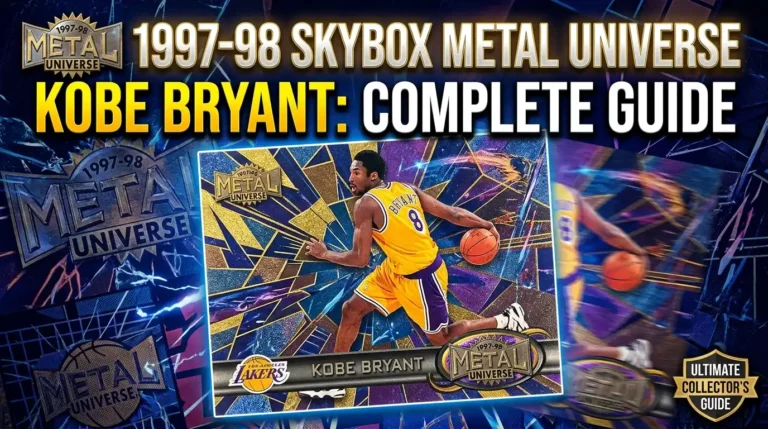
If you found a Kobe Bryant card in a shoebox and it says “Metal Universe” on the front or back, you’re holding one of the more recognizable pieces of 1990s basketball card design, and possibly something worth real money.
This guide breaks down exactly what these cards are, what drives their value, and what you can realistically expect to get for yours based on the version and grade you have.

![De quoi j'me rappelle (1997-98 Metal Universe Kobe Bryant Precious Metal Gems) [Explicit]](https://m.media-amazon.com/images/I/51RKGG7J99L._SL160_._SL160_.jpg "Kobe Bryant Metal Universe Cards: Value & Price Guide 2")


#Paid Links
Quick facts before you dig in:
- The base Kobe Bryant card is #81 in the 1997-98 Skybox Metal Universe set, from Kobe’s second NBA season.
- A rare parallel of this card, the Precious Metal Gems (PMG) Green, sold for $3.15 million in April 2026, the most ever paid for a single Kobe Bryant card.
- Most Kobe Bryant Metal Universe base cards are worth far less than that, typically somewhere between $30 raw and a few thousand dollars in top grades.
- The set is often confused with a different, earlier Fleer product simply called “Metal,” which has its own separate and valuable Kobe rookie cards.
Top 1 Kobe Bryant Metal Universe Cards
- 1997-98 Skybox Metal Universe #86 Kobe Bryant Los Angeles Lakers GMA 8.5
1. 1997-98 Skybox Metal Universe #86 Kobe Bryant Los Angeles Lakers GMA 8.5
#Paid Links
The 1997-98 Skybox Metal Universe #86 Kobe Bryant Los Angeles Lakers card is a graded NBA trading card that highlights Kobe Bryant during his early years with the Los Angeles Lakers.
This piece comes from the well-known 1997-98 Metal Universe set, a release that collectors often search for when looking into the Kobe Bryant Metal Universe card value and history.
The card is professionally graded GMA 8.5, which falls in the NM-MT+ range, meaning it shows strong centering, sharp corners, and clean surfaces with only minor wear.
Manufactured by Fleer, this card carries card number 86 and represents the NBA league from the 1997 season, making it a solid addition for anyone building a Kobe Bryant Metal Universe set.
Since the serial number may vary from copy to copy, each card carries its own unique identity while still holding the same design and grading standard.
Priced at $279.99, this listing gives collectors a way to buy a Kobe Bryant Metal Universe card without stepping into the higher price brackets seen with rarer variations like the green or PSA 10 versions.
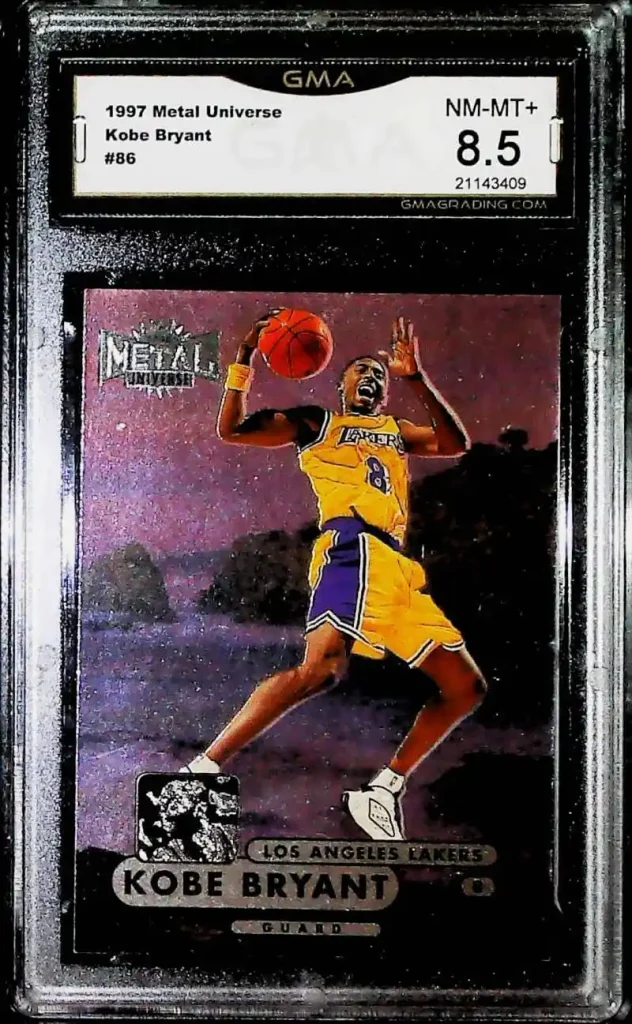
Image Credit: amazon.com
Key Features
- Card Number: 86
- Year: 1997
- League: NBA
- Manufacturer: Fleer
- Brand: Generic
- Team: Los Angeles Lakers
- Player: Kobe Bryant
- Grade: NM-MT+ 8.5
- Grading Company: GMA Graded
- Set: Metal Universe
- Serial number may vary
- Product Dimensions: 7 x 0.33 x 4 inches
- Item Weight: 0.17 ounces
| Pros | Cons |
|---|---|
| Officially graded GMA 8.5 NM-MT+ condition | Serial number may vary between copies |
| Features iconic player Kobe Bryant | Listed under a generic brand rather than a licensed authenticator name |
| Part of the recognizable 1997-98 Metal Universe set | |
| Good option for collectors looking for Kobe Bryant Metal Universe cards under $2,000 | |
| Compact and lightweight, easy to store or display |
My Opinion
I like the idea of this card because it fits nicely into the world of Kobe Bryant Metal Universe collectibles without requiring a huge budget.
Getting a graded NM-MT+ card at this price point feels like a reasonable way to own a piece of basketball history tied to the Los Angeles Lakers era of Kobe Bryant.
I appreciate that it comes from the original 1997-98 Metal Universe release, since that set is often mentioned alongside other notable versions like the 1997 Metal Universe Kobe Bryant Precious Metal Gems Green.
For someone who wants a Kobe Bryant Metal Universe card for sale that balances condition, price, and authenticity through grading, this seems like a fair middle ground.
I think cards like this one hold appeal for both new collectors and long-time fans who want something meaningful without chasing the rarest or most expensive versions on the market.
What Is the 1997-98 Metal Universe Set?
Metal Universe was a basketball card brand released by Skybox (under the Fleer/Skybox umbrella) for the 1997-98 NBA season. It’s known for its shiny foil card stock and bold, full-bleed action photography, a design language that made it instantly recognizable on shelves at the time.
Kobe Bryant appears as card #81 in the base set. Because 1997-98 was his second NBA season, this is technically a second-year card, not a rookie card, even though it’s often mistaken for one because of how early it falls in his career and how iconic the image has become. Collectors nicknamed the design the “Death Star” card because of the dark, metallic background behind Bryant.
Key takeaway: if your card simply reads “Metal Universe” with a plain, shiny foil background and no serial number, you almost certainly have the standard base card, not one of the rare inserts covered further down.
Metal Universe vs. Fleer Metal: Don’t Confuse These Two Sets
This is the single most common mix-up collectors run into, and it matters because the values are completely different.
| Feature | 1996-97 Fleer Metal | 1997-98 Metal Universe |
|---|---|---|
| Brand | Fleer | Skybox |
| Kobe’s card number | #181 (base) | #81 (base) |
| Season covered | Kobe’s rookie season | Kobe’s second season |
| Notable inserts | Cyber-Metal, Metal Edge, Precious Metal (different insert, same name idea) | Precious Metal Gems, Championship, Planet Metal, Platinum Portraits, Titanium |
| Typical base card raw value | Roughly $20 to $50 | Roughly $30 to $60 |
| Most valuable version | Precious Metal insert, low four figures in top grades | Precious Metal Gems Green, into the millions for the rarest examples |
If a listing or price guide has “1996” in the name, you’re looking at the earlier Fleer Metal product. If it says “1997-98,” you’re in Metal Universe territory, which is what this guide focuses on.
How Much Are Kobe Bryant Metal Universe Cards Worth?
Here’s where things get specific. Prices below reflect recent completed sale data (not asking prices) as tracked by sports card price guides, current as of September 2026. Because this is a thin, actively traded market, expect swings of 10 to 20 percent in either direction from one sale to the next, especially at the highest grades where very few copies exist.
Base Card (#81), by Grade
| Grade | Typical Recent Sale Price |
|---|---|
| Raw / ungraded | $30 to $65 |
| PSA 7 | $250 to $500 |
| PSA 8 | $700 to $900 |
| PSA 9 | $1,200 to $2,000 |
| PSA 9.5 | $1,500 to $2,900 |
| PSA 10 | $1,000 to $6,000 (highly volatile, low population) |
A useful way to think about it: going from PSA 8 to PSA 9 roughly doubles the price, and PSA 10 copies are scarce enough that individual sales can jump by thousands of dollars depending on how badly two bidders want that particular copy.
1997-98 Metal Universe Championship Parallel (#86)
The Championship version is a separate, less flashy parallel from the same set. It’s far more affordable and a good entry point if you want a piece of this set without spending big.
| Grade | Typical Recent Sale Price |
|---|---|
| PSA 8 | $20 to $40 |
| PSA 9 | $45 to $55 |
| PSA 10 | $150 to $225 |
Precious Metal Gems (PMG): The Rare Parallels
This is where the real money lives, and where the confusion usually starts.
Precious Metal Gems cards are serial-numbered parallels limited to exactly 100 copies per player. Of those 100:
- The first 10 (numbered 001 to 010) are the Green (“Emerald”) version. These are the true grail cards.
- The remaining 90 (numbered 011 to 100) are the Red version. Still rare and valuable, but far more attainable than the green.
| Version | Copies Made | Typical Value Range |
|---|---|---|
| PMG Green | 10 | $175,000 to $3.15 million, depending on grade and buyer |
| PMG Red | 90 | Roughly $50,000 to $560,000, depending on grade |
To put the record sale in perspective, here’s how the top Kobe Bryant card sales have climbed over the years:
| Date | Card | Price |
|---|---|---|
| March 2021 | 1996-97 rookie card (separate product) | $1.795 million |
| February 2022 | PMG Green, BGS 8.5, serial 100/100 | Just over $2 million |
| September 2025 | Solo Bryant card, prior record | $2.4 million |
| April 2026 | PMG Green, PSA 5, serial 009/100 | $3.15 million |
The April 2026 sale, purchased by the alternative asset platform Alt, became the record for the most expensive solo Kobe Bryant card ever sold. According to reporting on the sale, only three of the ten green PMG Kobe cards have ever been submitted to PSA for grading, and this particular copy, graded PSA 5, sits just below the single highest-graded example known.
Why does a PSA 5, a middling grade, sell for millions? Because with only 10 green copies ever produced and just 3 professionally graded, condition matters far less than existence. Collectors aren’t paying for a gem-mint surface here. They’re paying for one of the rarest, most historically significant pieces of Kobe Bryant memorabilia in the hobby, full stop.
Other Metal Universe Parallels to Know
Beyond Championship and PMG, Kobe’s 1997-98 Metal Universe card also exists in a few other, less commonly discussed parallels:
- Planet Metal: A rarer insert parallel with distinct foil treatment.
- Platinum Portraits: A portrait-style insert separate from the action-shot base design.
- Titanium: A metallic parallel variant.
These show up far less often in the resale market, so pricing data is thinner and less reliable. If you have one of these, get an opinion from a specialist grading service or an experienced dealer before pricing it off a general guide, since low sales volume makes broad price ranges unreliable.
What Actually Drives the Value of These Cards?
1. Scarcity of the specific parallel. A base card printed by the thousands will never approach the value of a parallel limited to 10 or 100 copies, no matter how good the photo looks.
2. Grade and condition. Foil cards from this era are notoriously prone to surface scratches, chipping, and centering issues, straight out of the pack. A high grade on a Metal Universe card is genuinely harder to find than on a plain cardboard card from the same year, which pushes up the price gap between grades.
3. Population reports. Grading companies like PSA publish how many copies of a card have been graded at each level. Fewer graded examples at the top of the scale generally means higher prices, especially for PMG parallels where total population is already tiny.
4. Historical significance and demand. Kobe Bryant’s continued popularity, combined with his early passing in 2020, has kept demand for his cards elevated across the entire hobby, not just this one set.
5. Market sentiment and headline sales. A single record-breaking sale, like the $3.15 million PMG Green purchase, tends to lift buyer interest and asking prices across the rest of the set for a period afterward, even on cards that aren’t directly comparable.
How to Identify Which Card You Have
Not sure what you’re holding? Work through this quickly:
- Check the year printed on the card back. “1997-98” means you’re in Metal Universe. “1996-97” means you have the separate Fleer Metal product.
- Check the card number. Base Metal Universe Kobe is #81. Championship parallel is also numbered #86 within its own insert set, and will say “Championship” somewhere on the card.
- Look for a serial number on the back. No serial number usually means a base card. A serial number formatted like “009/100” means you likely have a Precious Metal Gems parallel.
- Check the foil color if serial numbered. Green or emerald foil with a low serial number (1 through 10) is the rare green PMG. Red foil with a number from 11 through 100 is the red PMG.
- When in doubt, compare against sold listings. Search the exact wording from your card’s back (set name, card number, any insert name) against completed eBay sales to find visual matches.
Should You Get Your Card Graded?
Grading makes sense when the potential value increase clearly outweighs the cost of submission (which typically runs from around $20 to $50 per card at standard turnaround, more for premium services). Here’s a practical way to think about it:
- Base card in visibly sharp condition: Grading can be worth it if you suspect a PSA 9 or 10, since the price jump from raw to those grades is substantial relative to submission fees.
- Base card with visible wear, soft corners, or off-centering: Probably not worth grading. The raw value and a likely PSA 6 to 8 grade won’t cover the cost and wait time.
- Any Precious Metal Gems parallel: Almost always worth grading, given the values involved, but consider a specialist’s opinion first given how thin the sales data is at the top end.
- Championship parallel: Only worth grading if it’s genuinely pack-fresh, since even a PSA 10 tops out in the low hundreds of dollars.
Where to Buy and Sell Kobe Bryant Metal Universe Cards
- eBay remains the highest-volume marketplace for base and Championship cards, and completed listings (not active ones) are the best source for real pricing.
- PWCC Marketplace and Goldin handle higher-end consignments, including PMG parallels, and are worth using for anything you suspect is a red or green PMG.
- Specialty auction houses (Heritage Auctions, SCP Auctions) periodically list ultra-rare examples, including autographed or top-population PMG cards.
- Local card shops can be useful for quick, in-person sales of common base cards, though expect offers below full market value in exchange for speed and convenience.
Buying tip: always confirm whether a listed price is an actual completed sale or just an asking price. Asking prices, especially for PMG parallels, are frequently inflated well above what buyers actually pay.
Common Mistakes Collectors Make
- Assuming “Metal Universe” and “Metal” are the same set. They’re not, and mixing them up leads to wildly wrong value expectations.
- Calling the base card a “rookie card.” It’s a second-year card. Kobe’s actual rookie season is 1996-97.
- Pricing a red PMG using green PMG sale data (or vice versa). These have completely different value tiers despite looking similar at a glance.
- Grading a worn common card expecting a big return. Submission costs and turnaround time rarely pay off on lower-condition base cards.
- Trusting active listing prices as market value. Only completed, confirmed sales reflect what buyers are actually paying.
Key Takeaways
- Kobe Bryant’s 1997-98 Metal Universe base card is #81, a second-year card, not a rookie card.
- Standard base cards range from around $30 raw to a few thousand dollars in a top PSA 10.
- The Championship parallel is an affordable way into the set, generally under $250 even in top grade.
- Precious Metal Gems parallels are the real value drivers: red versions can reach the hundreds of thousands, and the ultra-rare green versions have sold for over $3 million.
- Don’t confuse this set with 1996-97 Fleer Metal, a separate product with its own distinct Kobe Bryant cards.
You May Also Like to Read:
- Kobe Bryant Insert Cards: A Collector’s Guide to Value, Rarity, and Prices
- Kobe Bryant Precious Metal Gems: The Complete Value and Price Guide
FAQs
What is the Kobe Bryant Metal Universe card worth?
It depends entirely on the version and grade. A standard raw base card is typically worth $30 to $65. A PSA 10 base card can reach into the low thousands. A Precious Metal Gems red parallel can be worth tens to hundreds of thousands, and the rare green parallel has sold for as much as $3.15 million.
Is the Kobe Bryant Metal Universe card a rookie card?
No. It’s a second-year card from the 1997-98 season. Kobe’s rookie season was 1996-97, and his rookie cards come from separate products released that year.
Why did a Kobe Bryant card sell for $3.15 million?
That sale was for a 1997-98 Metal Universe Precious Metal Gems Green parallel, one of only 10 ever produced for Kobe Bryant. Its extreme scarcity, combined with strong ongoing demand for Bryant memorabilia, drove the record price.
How many Kobe Bryant Precious Metal Gems cards exist?
Exactly 100: 10 green (numbered 001 to 010) and 90 red (numbered 011 to 100).
What’s the difference between the green and red Precious Metal Gems parallels?
The green version is limited to the first 10 serial numbers and is dramatically rarer and more valuable. The red version covers the remaining 90 copies and, while still valuable, sells for a small fraction of the green’s price.
How do I know if my card is a Precious Metal Gems parallel?
Look for a serial number printed on the back, typically formatted like “009/100.” Base cards have no serial number at all.
Is the 1997-98 Metal Universe Championship card the same as the base card?
No. Championship is a separate insert parallel, numbered #86, with different design elements. It’s much more affordable than the base card in most grades.
Should I get my Kobe Bryant Metal Universe card graded?
Only if it’s in genuinely sharp, pack-fresh condition or if it’s a Precious Metal Gems parallel. Grading a worn common base card rarely pays off given submission costs.
Where can I sell a Kobe Bryant Metal Universe card?
eBay works well for base and Championship cards. For Precious Metal Gems parallels, consider PWCC Marketplace, Goldin, or a specialty auction house given the values involved.
Are prices for these cards going up or down?
Base card and Championship prices have stayed relatively stable, with normal short-term swings. PMG values, especially the green parallel, have trended sharply upward, driven by a series of record-setting sales through 2025 and 2026.
What does “Death Star” mean on this card?
It’s a collector nickname for the base card’s design, referring to the dark, metallic foil background behind Kobe’s action photo. It’s not an official card name.
Can I find a Kobe Bryant Metal Universe card autographed?
Autographed examples exist but are extremely rare. A one-of-a-kind autographed Precious Metal Gems card sold at auction for over $400,000 in 2022, reportedly the only known signed PMG Kobe Bryant card in the hobby.
Is this the same set that had a Michael Jordan card sell for a huge price?
Yes. The 1997-98 Metal Universe Precious Metal Gems set also includes Michael Jordan, and his red parallel has sold for hundreds of thousands of dollars, showing the format’s value isn’t unique to Bryant.
What other players are valuable in this Precious Metal Gems set?
Alongside Bryant and Jordan, the set includes Tim Duncan’s rookie card and Shaquille O’Neal, both of which carry significant value in their green parallel versions.
Why do prices vary so much between listings for the same grade?
This is a thin market, especially at higher grades and for PMG parallels. With few copies changing hands, individual buyer motivation can swing the final price considerably from one sale to the next.
One Comment