Kobe Bryant Score Board Rookie Cards: What It’s Really Worth
If you’ve come across a 1996-97 Score Board Basketball Rookies Kobe Bryant card and typed his name into eBay, you’ve probably noticed something confusing. Some copies sell for $8. Others sell for $600. Same card, wildly different prices.
That gap isn’t a mistake. It comes down to grading, condition, and a few facts about this card that most listings never explain. I pulled current market data, PSA population numbers, and recent completed sales to put together a straight answer: what this card is, what it’s worth today, and whether it’s worth buying.


#Paid Links
Quick facts: The card is #15 from the 1996 Score Board Basketball Rookies set, made by The Score Board, Inc. It shows Kobe in his white Lower Merion High School uniform, not a Lakers jersey, because it was released before his rookie NBA season. Raw copies typically sell for $6 to $15. PSA 10 copies have recently sold between $175 and $695, with most 2026 sales landing between $375 and $600.
Top 1 Kobe Bryant Scoreboard Rookie Cards
- 1996 Score Board Rookie Card #15 Kobe Bryant Lower Merion High School LA Lakers RC
1. 1996 Score Board Rookie Card #15 Kobe Bryant Lower Merion High School LA Lakers RC
#Paid Links
The 1996 Score Board Rookie Card #15 featuring Kobe Bryant is a piece of basketball history captured right at the start of his journey. This Kobe Bryant Scoreboard Rookie Card shows him representing Lower Merion High School before he became a Los Angeles Lakers legend, making it a unique addition for any Kobe Bryant rookie card collection.
Card number 15 from the 1996 Score Board set carries the RC designation, confirming its status as an official rookie card. It is listed under the League NBA and Team Los Angeles Lakers, tying it directly to Kobe’s early professional path.
This particular Kobe Bryant Scoreboard Rookie Card comes with a Grade Rating of M for Mint, with grading provided by the seller. It is compact in size, with package dimensions of about 4 x 3 x 0.2 inches and a light item weight of 1.6 ounces, making it easy to store, display, or add to a protective case.
Priced at $44.99, this 1996 Scoreboard Kobe Bryant 15 card holds a Best Sellers Rank of #8,332 in Sports Collectibles and #3,179 in Sports Collectible Single Base Trading Cards. With a rating of 4.1 out of 5 stars from 14 reviews, it remains a recognizable option for collectors searching for a Kobe Bryant Scoreboard Rookie Card for sale.
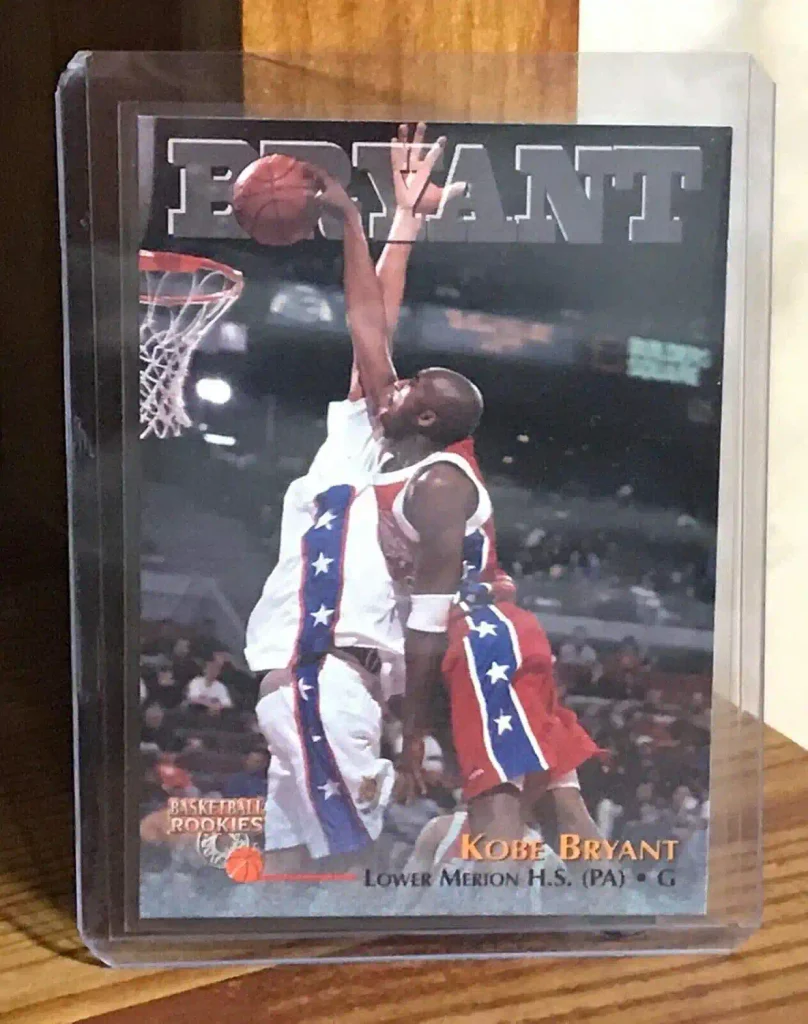
Image Credit: amazon.com
Key Features
- 1996 Score Board Rookie Card #15 featuring Kobe Bryant
- Card shows Kobe Bryant during his Lower Merion High School days
- Officially marked as an RC, or rookie card
- Associated Team listed as Los Angeles Lakers
- League listed as NBA
- Brand listed as Rookie
- Grade Rating of M for Mint, graded by the seller
- Card Number 15 from the Year 1996
- Package Dimensions of approximately 4 x 3 x 0.2 inches
- Item Weight of 1.6 ounces
- Priced at $44.99
- Rated 4.1 out of 5 stars based on 14 customer reviews
- Ranked #8,332 in Sports Collectibles and #3,179 in Sports Collectible Single Base Trading Cards
| Pros | Cons |
|---|---|
| Features Kobe Bryant as a rookie, tied to his Lower Merion High School and Lakers history | Grading is provided by the seller rather than a major third-party grading company |
| Officially marked RC for rookie card collectors | Limited technical details are listed for the card |
| Compact and lightweight, easy to store or display | |
| Affordable price point for a Kobe Bryant rookie card | |
| Rated 4.1 out of 5 stars by previous buyers |
My Opinion
When I look at what makes a Kobe Bryant Scoreboard Rookie Card stand out, it comes down to the story behind it. A card that captures him at Lower Merion High School, right before his Lakers career began, feels different from a standard rookie card. That early connection to his roots is part of what makes this 1996 Scoreboard Kobe Bryant 15 card appealing to collectors who care about the full picture, not just the NBA years.
I also like that the price stays approachable at $44.99. Many Kobe Bryant rookie cards climb well beyond what an everyday collector can justify. Having an affordable entry point into this part of his card history feels like a fair way to start or grow a collection without a huge financial commitment.
The Mint grade rating adds to the appeal as well. Even with seller-based grading, a Mint designation suggests the card has been kept in strong condition, which matters a lot for anyone thinking about long-term value. For someone drawn to Kobe Bryant rookie cards that mix affordability with meaningful history, this is the kind of card I would seriously consider.
What Is the Score Board Kobe Bryant Rookie Card?
The 1996 Score Board Basketball Rookies Kobe Bryant #15 is a rookie card issued by The Score Board, Inc., a company better known at the time for autographed memorabilia than for mainstream trading cards. The set focused on prospects heading into the 1996 NBA Draft, which is why Kobe is shown in his Lower Merion High School jersey instead of Lakers gear.
This matters for one simple reason: it’s technically a pre-draft card, not a licensed NBA product from a major manufacturer like Topps, Upper Deck, or Fleer. Score Board didn’t have an NBA license, so you won’t see league logos on the card. Collectors sometimes call this the “high school Kobe” card to tell it apart from his NBA rookie cards released later that same season by Topps, Upper Deck, Fleer, SkyBox, and Stadium Club.
Card details at a glance:
| Detail | Information |
|---|---|
| Set | 1996 Score Board Basketball Rookies |
| Card number | #15 |
| Manufacturer | The Score Board, Inc |
| Photo | Kobe Bryant, Lower Merion High School uniform |
| License | Unlicensed (no NBA or team logos) |
| Rookie card status | Yes |
| Print run | Not officially disclosed |
| Estimated total graded population | Roughly 3,900 cards across all grades (PSA) |
There’s also a separate, much rarer autographed version of this card in Score Board’s Autographed Basketball and Autographed Collection sets. If a listing mentions an autograph, that’s a different card entirely, with a different price range, and it’s worth confirming before you compare prices.
How Much Is the Kobe Bryant Score Board Rookie Card Worth?
Here’s the short answer, based on completed sales tracked through early September 2026: raw copies sell in the single digits to mid teens. Mid grade copies (PSA 6 to 8) run from about $15 to $60. PSA 9 copies typically bring $45 to $80. PSA 9.5 copies land in the $40 to $165 range depending on the grading company. PSA 10 copies are the real outlier, with recent sales between $175 and $695.
Price by Grade (Recent Completed Sales)
| Grade | Typical Sale Price | Notes |
|---|---|---|
| Raw/Ungraded | $6 to $16 | Most common condition, high supply |
| PSA 5 to 6 | $8 to $30 | Visible wear, still collectible |
| PSA 7 | $10 to $45 | Solid entry point for graded copies |
| PSA 8 | $20 to $60 | Most popular graded tier |
| PSA 9 | $45 to $80 | Strong demand, large population |
| PSA 9.5 (SGC/BGS/CGC) | $40 to $165 | Wide range by grading company |
| PSA 10 | $175 to $695 | Volatile, trending upward through mid 2026 |
A quick note on that PSA 10 range. Prices for gem mint copies climbed steadily across 2026, from roughly $175 to $300 in early winter, up to $500 to $700 by August. That’s a real trend, not just noise from one or two sales, but it also means a PSA 10 bought today could look expensive in six months if the market cools, or cheap if it keeps climbing. Treat any single PSA 10 sale as one data point, not gospel.
Callout: Why is the raw card so cheap compared to the graded version? Because this set was mass produced and never carried a premium reputation, raw copies flood the market constantly. Grading adds real value here mainly because it filters out the centering and surface issues this set is known for, not because the card itself is scarce.
Why This Card Is Worth Less Than Kobe’s Other Rookie Cards
If you’ve shopped for a Kobe Bryant rookie card before, you’ve likely seen his Topps #138, Upper Deck SP #134, Stadium Club #R1, or Finest rookies selling for far more in similar grades. There are three real reasons the Score Board card sits lower in the pecking order.
- No NBA license. Collectors have always valued licensed cards from major manufacturers more highly than unlicensed sets, and Score Board’s Basketball Rookies release never carried the same prestige as Topps or Upper Deck.
- Large graded population. PSA’s population report shows roughly 3,900 total graded copies of this card, with about 1,450 to 1,470 graded PSA 9 and another 437 to 445 graded PSA 10. That’s a lot of high grade copies for a 1990s card, which keeps a lid on prices at every tier except the very top.
- It’s a pre-draft photo, not a rookie season card. Some collectors specifically want a player’s first card in his NBA uniform. This card shows Kobe in high school, which some buyers see as a novelty rather than a true rookie card, even though it meets the technical definition.
None of that makes the card unimportant. It’s still one of the earliest Kobe Bryant cards ever produced, and it has genuine appeal to collectors who focus on his pre-NBA story. It’s just priced like what it is: an affordable, historically interesting card rather than a blue chip investment piece.
PSA Population Report: How Rare Is Gem Mint, Really?
Population reports tell you how many copies of a card have been graded at each level. Here’s the current PSA breakdown for this card, current as of the most recent monthly update:
| PSA Grade | Approximate Population |
|---|---|
| PSA 1 | 0 |
| PSA 2 | 4 |
| PSA 3 | 6 |
| PSA 4 | 20 to 21 |
| PSA 5 | 60 to 64 |
| PSA 6 | 174 to 181 |
| PSA 7 | 205 to 215 |
| PSA 8 | 749 to 773 |
| PSA 9 | 1,450 to 1,470 |
| PSA 10 | 437 to 445 |
Two things jump out here. First, almost 90 percent of graded copies land at PSA 8 or higher, which tells you this card was well printed and grades easily when it’s been stored properly. Second, 437 to 445 copies at PSA 10 is not a small number for a specialty 1990s issue. Compare that to a card with a true PSA 10 population under 50, and you’ll understand why gem mint Score Board Kobes sell for hundreds, not thousands.
Key takeaway: This isn’t a scarce card in absolute terms. It’s a moderately available card where quality still costs a real premium because so few copies are truly flawless out of the pack.
Buying Guide: What to Check Before You Buy
Whether you’re buying raw or graded, a few checks will save you from overpaying or getting a card in worse shape than photos suggest.
If buying raw:
- Check centering carefully. This set is known for off-center printing, and slight miscuts are common straight from wax packs.
- Look at corners under strong light. High school-era Score Board stock shows wear easily.
- Ask for close-up photos of all four corners and both surfaces before paying, especially on higher priced raw listings.
- Confirm it’s the base rookie card, not the autographed parallel, unless that’s specifically what you want.
If buying graded:
- Verify the certification number on PSA’s, SGC’s, or BGS’s own website. Don’t take a seller’s word for it.
- Understand that PSA 10 and BGS 10/SGC 10 do not always sell for the same price. The market pays a premium for PSA specifically, and lower grade cards from other companies often sell for noticeably less than PSA of the same number, per current market data.
- Check sold listings, not active listings, before you buy. Active “Buy It Now” prices are frequently set well above what cards actually sell for.
Common mistakes to avoid:
- Paying PSA 10 prices for a BGS or SGC 9.5, assuming they’re equivalent. They aren’t always.
- Confusing this card with the Score Board autographed version, which carries a completely different price.
- Assuming a raw card described as “gem mint” by the seller will actually grade a 10. Given the population data, most won’t.
Should You Grade This Card?
If you own a raw copy and it looks sharp under a loupe (tight centering, clean corners, no surface print lines), grading can make sense. The jump from raw to PSA 8 alone can multiply the card’s value several times over, and PSA 9 to PSA 10 is where the real money sits.
That said, run the math first. Grading fees plus shipping typically run $15 to $30 or more per card depending on turnaround speed and the grading company you choose. If your card looks like a PSA 6 or 7 candidate, the graded value may not clear the cost of grading plus the risk of a lower than expected grade. Reserve grading for copies that genuinely look gem mint to your eye first.
Where to Buy the Kobe Bryant Score Board Rookie Card
This card is widely available through mainstream marketplaces. eBay carries the deepest inventory across every grade and price point, and its completed listings are the most reliable free source for real sale prices. Specialty sites that track sports card pricing aggregate those same eBay sales into grade by grade price guides, which is useful for a quick gut check before you buy or sell.
Auction houses handle the rarer autographed parallels and any higher end lots more often than the standard rookie card. Local card shops and card shows are worth checking too, especially for raw copies, since in-hand inspection lets you catch centering and corner issues that photos can hide.
You May Also Like to Read:
- Kobe Bryant Framed Signed Jerseys: What They’re Really Worth (And How to Buy One Safely)
- Kobe Bryant Coloring Pages: Free Printable Lakers Basketball Fun for Every Age
FAQs
Is the Score Board Kobe Bryant rookie card rare?
No, not in absolute terms. PSA has graded nearly 3,900 copies, with the majority landing at PSA 8 or 9. It’s a widely available card, though PSA 10 copies are meaningfully scarcer than the rest of the population.
What is the Score Board Kobe Bryant card actually worth raw?
Recent completed sales put raw, ungraded copies between roughly $6 and $16, depending on centering and corner condition.
Why is Kobe wearing a high school jersey on this card?
The card was part of a pre-draft prospects set released before the 1996 NBA Draft, so Kobe is shown in his Lower Merion High School uniform rather than a Lakers jersey.
Is this considered an official rookie card?
It’s widely recognized in the hobby as one of Kobe’s rookie cards since it predates his NBA career, though some collectors prefer his NBA uniform rookie cards from Topps, Upper Deck, and other licensed sets.
What’s the difference between the Score Board rookie card and the Score Board autographed version?
The standard #15 rookie card has no signature and is the subject of this guide. The autographed versions come from separate Score Board sets, carry an authenticated Kobe Bryant signature, and sell for significantly more, often several hundred dollars depending on grade and condition.
Is PSA 10 worth chasing on this card?
Only if you’re comfortable with price volatility. Sales have ranged from $175 to nearly $700 within a single year, so timing and demand swings matter more here than on more established, lower population cards.
Does BGS or SGC grade this card the same as PSA?
Grading standards differ slightly between companies, and the market has consistently paid more for PSA labeled cards over BGS, SGC, or CGC at equivalent numeric grades on this specific card.
Where can I check current PSA population numbers myself?
PSA publishes a public population report on its own website that updates monthly, listing exact counts at every grade for any card by set and number.
Is this card a good investment?
It’s better viewed as an affordable historical piece than a growth investment. The large graded population at PSA 8 and 9 limits upside outside of true gem mint copies.
Should I buy raw or graded?
Buy raw if you want the card for a low cost and don’t mind some condition variance. Buy graded if you want price certainty and are comfortable paying more for verified condition, especially at PSA 9 or PSA 10.
Can I get this card professionally graded even if it’s decades old?
Yes. Age doesn’t disqualify a card from grading. Condition at the time of submission is what determines the grade.
Are there fakes of this card in circulation?
Reprints and unauthorized copies exist for many popular 1990s cards. Buying from established sellers with return policies, and checking certification numbers on graded copies, reduces this risk significantly.
What other Kobe Bryant rookie cards should I compare this to?
His Topps #138, Upper Deck SP Premier Prospects #134, Stadium Club #R1, Fleer #233, SkyBox Premium, and Bowman’s Best #R23 are the most recognized alternatives, all typically priced higher than the Score Board card in equivalent grades.
Does card condition affect price as much as the grade number suggests?
Yes. Two cards graded the same number can still sell differently based on subtleties like eye appeal, print quality, and whether the grading label notes any qualifiers.
One Comment